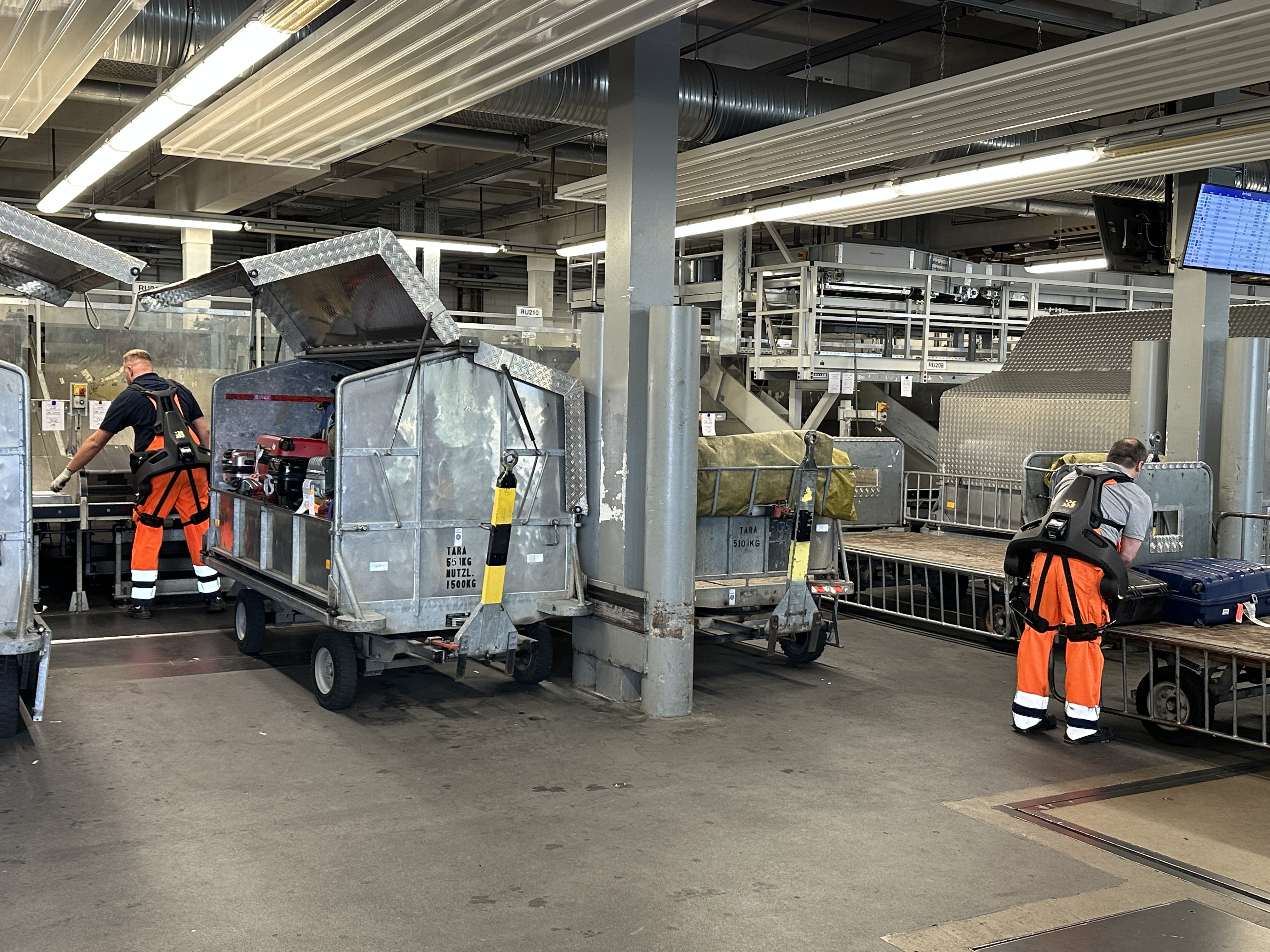
Human-centric robotics supports airport teams in physically demanding workflows with up to 38 kg / 84 lbs of adaptive lifting assistance per movement
MUNICH, GERMANY, August 27, 2026 /EINPresswire.com/ — From loading baggage on the apron to moving heavy cargo in the warehouse, ground handling remains one of the most physically demanding areas of airport operations. At GSE Expo Europe 2026 in Lisbon, September 15–17, German Bionic will demonstrate how its AI-powered EXIA exoskeleton can support the people performing these essential tasks.
At booth C01A, German Bionic will showcase EXIA for applications across baggage handling, ground handling and air cargo. The active exoskeleton provides up to 38 kg / 84 lbs of adaptive lifting assistance per movement and dynamically supports workers when lifting, lowering and carrying, as well as during work in forward-bent positions.
While automation is transforming aviation, many essential airport workflows still depend on people. Baggage needs to be moved between conveyor belts and carts, aircraft must be loaded and unloaded, and cargo of widely varying shapes and weights needs to be handled in warehouses, containers and on the apron. Especially where loads, movements and situations constantly change, human flexibility, perception and decision-making remain essential.
“The airport of the future will not consist exclusively of autonomous machines. There will still be people handling baggage and cargo, responding to unexpected situations and keeping operations moving,” says Benjamin Schulz, CEO of German Bionic. “This is exactly who we develop human-centric robotics for: the people doing the job. Our approach is to automate where automation makes sense and augment people where their capabilities remain indispensable.”
Human-Centric AI and Robotics that Adapt to the Individual
The physical demands of airport operations vary considerably. No two workers move in exactly the same way, and no two lifts are identical. This is where EXIA’s Physical AI comes into play.
Integrated sensors capture movements in real time, while its AI-powered control system recognizes different movement patterns and dynamically adjusts support to the task and the individual user. Rather than requiring workers to adapt to the machine, the technology adapts to the person wearing it.
The system draws on billions of real-world human motion data points gathered from actual workplace applications. This real-world data foundation is a key technological differentiator for German Bionic and enables the company to continuously refine how EXIA responds to individual users and movements.
“People move differently. Two people lifting the same piece of cargo will never perform exactly the same movement,” says Norma Steller, Co-CTO of German Bionic. “That is why Physical AI cannot simply be based on a theoretically programmed motion sequence. EXIA learns from real-world human movement data, enabling it to understand very precisely what an individual user is doing and what kind of support is needed. Our unique advantage is that we have the real-world usage data from our systems in the field. This allows us to continuously make Physical AI more precise, more adaptive and more individual.”
As a connected system, EXIA can also continuously evolve through software and over-the-air updates.
From Baggage Handling to Air Cargo: Real-World Examples
Two deployments highlighted in aviation and industry media show how German Bionic’s exoskeleton technology is already supporting physically demanding work at airports.
At Nuremberg Airport, German Bionic exoskeletons have been in regular use in baggage handling since March 2024, following a successful test phase. A typical passenger aircraft can carry up to 200 pieces of luggage, with an average weight of 15 to 20 kg / 33 to 44 lbs per bag. During peak periods, baggage handlers can lift, carry and load a ton or more of luggage in a single day.
The exoskeletons support employees when lifting, lowering and carrying baggage and during work in forward-bent positions, while adapting flexibly to the individual movements of the wearer. The aim is to reduce strain on the lower back while maintaining the freedom of movement required for everyday baggage handling. The systems have been in regular operation at the airport since March 2024.
At Maastricht Aachen Airport, EXIA is being used in daily air cargo operations. The deployment has attracted attention across international aviation trade media and provides another example of how human-centric robotics can be integrated into existing airport workflows. Maastricht Aachen Airport is the first airport in the Netherlands to deploy EXIA in its daily cargo handling operation. The system supports employees handling freight on both the apron and in the cargo warehouse, providing up to 38 kg of adaptive lifting assistance while preserving natural freedom of movement.
Together, the two examples illustrate the range of applications for human-centric robotics in aviation: from highly repetitive passenger baggage handling to complex air cargo operations involving changing loads and workflows.
Automation Where Possible, Augmentation Where People Matter
For German Bionic, automation and human augmentation are complementary rather than competing approaches. Predictable and standardized processes will increasingly be automated. At the same time, airport operations will continue to include tasks involving irregular loads, changing environments and complex workflows where people remain indispensable.
Physical AI offers an additional approach: intelligent robotic systems that understand physical work and support people while they perform it.
This is particularly relevant as airports, airlines and ground handling operators face labor shortages and an aging workforce. Physical strain and fatigue are not only occupational health and safety issues. They also affect absenteeism, employee retention and the long-term attractiveness of physically demanding jobs.
By bringing human-centric robotics directly into existing workflows, German Bionic aims to support the people who keep airport operations moving while enabling them to retain the flexibility and decision-making capabilities that make human work essential.
Experience EXIA at GSE Expo Europe 2026:
September 15–17, 2026
FIL – Feira Internacional de Lisboa, Lisbon, Portugal
Booth C01A
About German Bionic
German Bionic is a European technology leader in Physical AI and human-centric robotics. The company develops intelligent active exoskeletons that support people performing physically demanding work. German Bionic systems combine robotics, sensors and artificial intelligence and are used across industries including logistics, manufacturing, healthcare and aviation. Its AI-powered EXIA exoskeleton provides up to 38 kg / 84 lbs of adaptive lifting assistance per movement and dynamically adapts its support to the user, movement and task.
Eric Eitel
German Bionic
+49 160 90370421
ee@germanbionic.com
Visit us on social media:
LinkedIn
Instagram
YouTube
Legal Disclaimer:
EIN Presswire provides this news content “as is” without warranty of any kind. We do not accept any responsibility or liability
for the accuracy, content, images, videos, licenses, completeness, legality, or reliability of the information contained in this
article. If you have any complaints or copyright issues related to this article, kindly contact the author above.

Media gallery